Recruit-AI
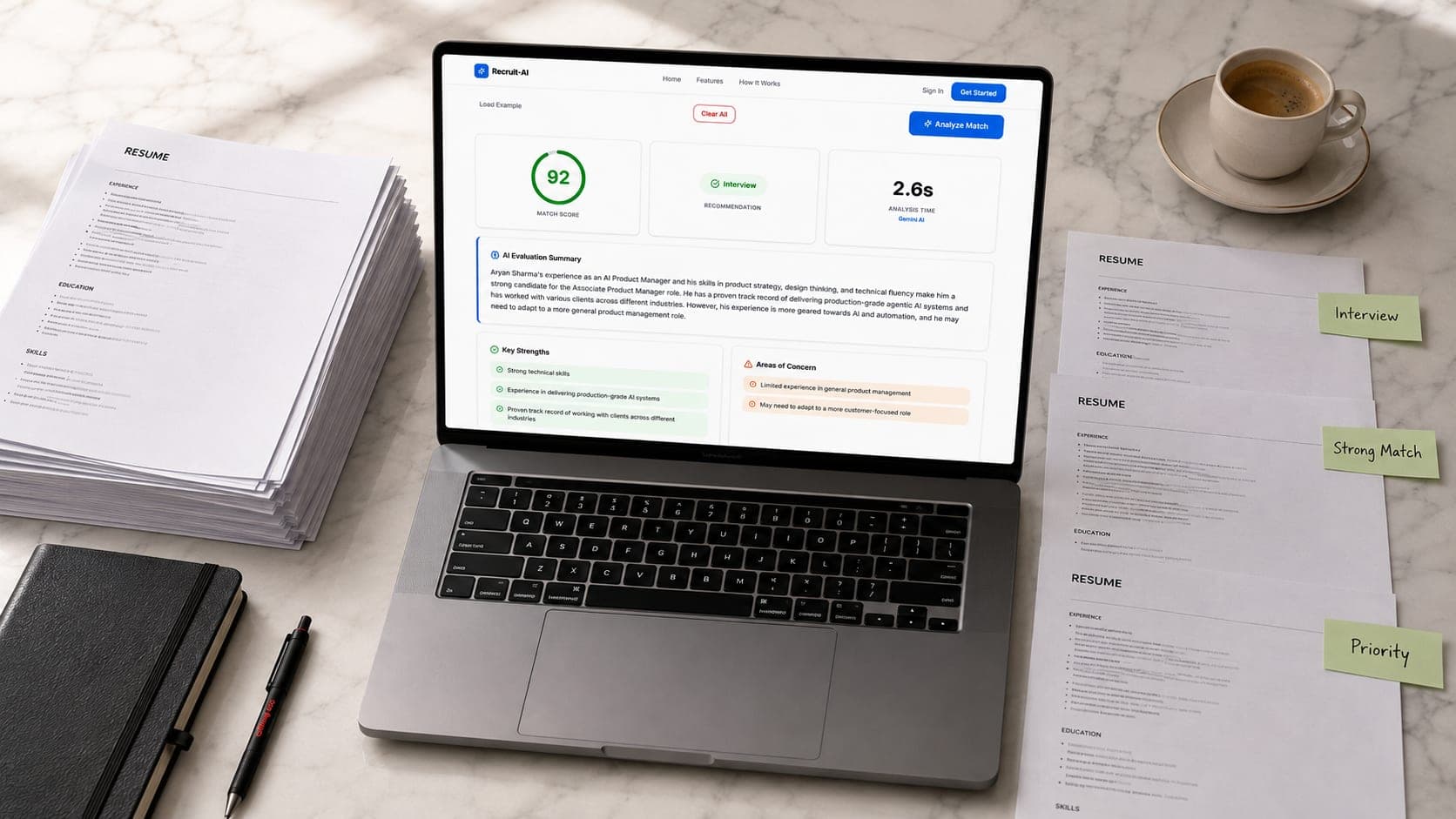
Recruit-AI reads every resume the way a senior recruiter would — evaluating context and implied skills, not keyword proximity — and returns a 100-point match score, strengths breakdown, gaps analysis, and ready-to-send email draft in under 10 seconds.
Built for IIT Patna iHub. Scored 10/10. Still runs.

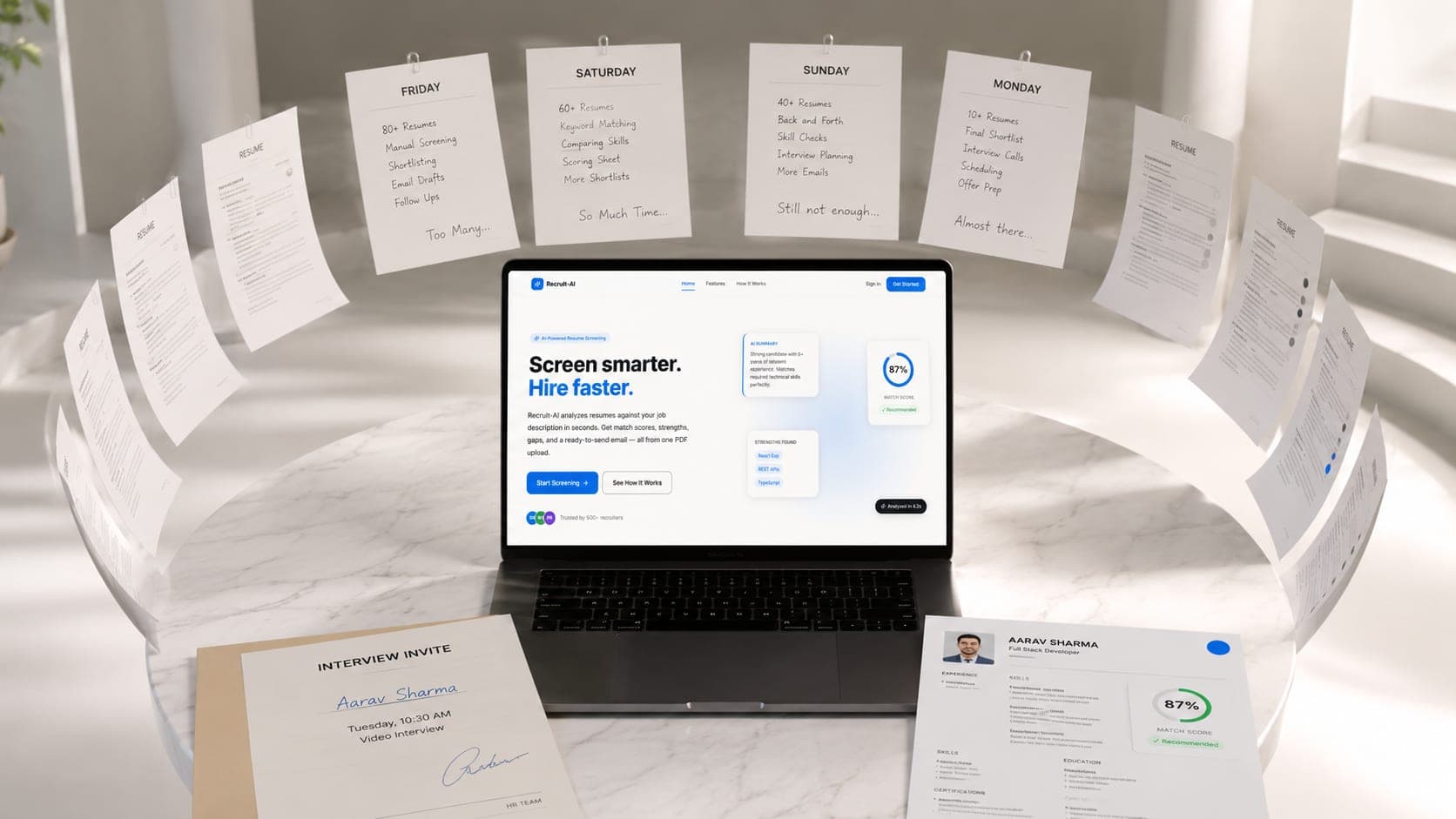
Every ATS on the market was built around the same incorrect premise: that screening a resume is a pattern-matching problem. It is not — and keyword filters prove it every time they reject a candidate with four years of React experience who described it as component-based frontend architecture. The first pass on a resume is a reasoning problem, and AI is now better at reasoning under volume than any human reading PDF number 47 on a Monday afternoon. I built Recruit-AI so that recruiters never spend their judgment on a resume they were going to reject anyway.
Overview
The moment a recruiter pastes a job description and uploads a resume PDF, a thirteen-node pipeline extracts the document text regardless of layout, passes both to Gemini for contextual reasoning across skills, experience, and role alignment, and returns a 100-point match score, summary, strengths, gaps, a binary recommendation, and a ready-to-send personalised email draft — in under 10 seconds.
The Single-Pass Evaluation Engine
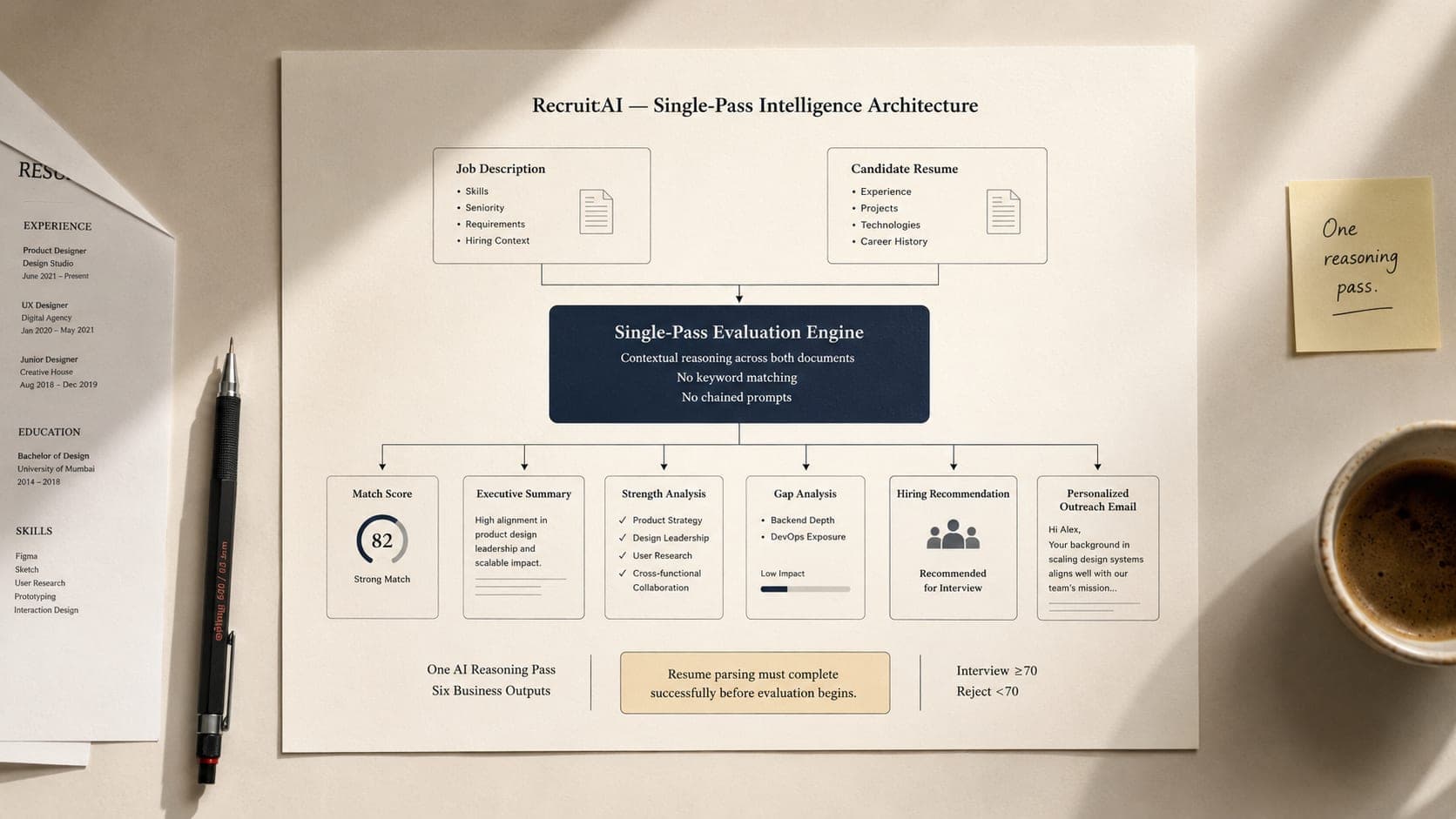
The evaluation engine runs in a single Gemini call. The prompt asks Gemini to read both documents together — evaluating skills overlap, experience depth, seniority signals, and implied competencies that keyword filters cannot detect — and return one structured JSON object with all six outputs simultaneously: match score, summary, strengths, gaps, recommendation, and email draft. The Interview threshold is set at 70, not higher, because resume screening tolerates false positives differently than lead qualification — missing a great candidate is a worse outcome than spending 30 seconds on a borderline one. Before the evaluation begins, the pipeline validates that the extracted PDF text is at least 100 characters. An image-based PDF returns an empty string. Without this guard, Gemini receives empty input and produces a confident but entirely fabricated evaluation of a candidate it knows nothing about. That failure mode was designed out before the system was deployed.
Thirteen Nodes. One Call. Zero Infrastructure Cost.
The workflow runs as a thirteen-node sequential pipeline. A Cloudflare Zero Trust tunnel on Oracle Cloud provides the permanent HTTPS endpoint. A binary conversion node prepares the PDF for n8n's built-in Extract from File node, which pulls all readable text regardless of layout, column count, or formatting. An IF node validates the extraction returned at least 100 characters — the guard against image-based PDFs that silently return empty strings. The Prepare Gemini Request node explicitly references the Input Validation node by name to retrieve the job description, because the PDF extraction step only passes forward its own output and the JD would otherwise be lost mid-pipeline without any visible error. The Basic LLM Chain sends the assembled prompt to Gemini 1.5 Flash and receives all six evaluation outputs in one response. Oracle, Gemini, Supabase, and Cloudflare all run on permanent free tiers. Infrastructure cost: zero.
Whatmadeitwork.
If I rebuilt it: I'd add a calibration layer where the recruiter marks interview outcomes and the system adjusts its scoring weights accordingly. A 70 threshold is defensible — but the right threshold for a specific role at a specific company should emerge from that company's own hiring data, not from a fixed rubric.
10Seconds.10Outof10.TheResumeThatGotReadonFridayNight.
Recruit-AI is live in production on Oracle Cloud — average evaluation time 8 to 12 seconds including database write, JSON output validity 100% across all test runs, and AI scores aligned with senior recruiter assessments across every live test case, including a 75% match on the builder's own resume against a real AI PM job description, independently rated as exactly accurate by a senior recruiter reviewing the same materials. The project was submitted to IIT Patna iHub as the AI Product Management capstone and received a 10/10 — not for a Figma prototype, but for a live webhook, deployed frontend, populated database, and a real-time demonstration of the system processing a resume PDF end-to-end. When the best candidate for your React role applied on Friday at 11pm, Recruit-AI read their resume in 8 seconds, scored it 89, and drafted the invitation email before Monday started. Your competitor responded in three days. By then, the hire was already gone.